Free Casino Bonus Credits and Its Essential Rules

Online casino preoccupations have been drawing massive gathering and one of the basic roles for it is the bonuses that the diversions offer to a player on the web. Free casino bonus credits are offered to a player now and then. It is given to a card shark for different reasons; may be as a spurring power to change over to playing at authentic casinos.

Aside from that, this sort of credits likewise helps in attracting new players to the internet betting locales. Notwithstanding, various standards are there to getting them. In this manner, it is vital for a player to comprehend them legitimately. There are some online casino destinations that give a bonus measure of up to 100.

At the point when a player will unite with that site, 100 credits will be spared in his casino account. It may so happen that the player can be requested to store a proportional total from money for being one of the conditions of getting the casino bonus credits. After the record opens and the money is traded, an examiner can start of playing the redirection.

Other than the above prerequisite, the players can be approached to bet the entire free casino bonus, which was offered to them before they proceed to take out cash from the online casino record of theirs. This measure of cash is should have been bet before any withdrawal happens.

This was so far about opening a record with an online casino gaming site insättningsfria casino bonus and getting the bonus entirety. There is another way where the players in the wake of displaying new players through referral program can pick up their credit money. It works comparatively as above.

What the player needs to ensure here is that the referral is entered before different joins and opens a record. This is to insist that the player making the referral will get casino bonus attributes that he is qualified for. Getting them is without a doubt a matter of outrageous fun and fervor.

There are a couple of online casino preoccupations available on the web, which consolidate craps, openings, video poker, roulette, blackjack, etc. The free bonus credits of casino goals are an astounding technique for growing the triumphant whole. In any case, before starting with an entertainment on the web, one should out and out gather data on the redirection as that manufactures the chance of winning it.

LA FC Proves to be Too Much for DC United

Two of the MLS’ best teams squared off in Washington D.C. on Saturday, with Los Angeles FC and DC United going toe-to-toe, but the match didn’t exactly deliver on expectations, as it was fairly one-sided. https://omegatipsters.com/betting-tips/football/1×2 had predicted that the match would be a close one and slightly favored Los Angeles FC.

Star striker Carlos Vela was a thorn in United’s side throughout the game, especially in the first half. He was presented with a huge opportunity from the get-go, just 10 minutes into the match, when a ball was served into the box, and Leonardo Jara elected to slide with his hand out, in an effort to block a ball that was headed for the penalty area. A penalty was awarded for the hand ball, which Vela took.

Goalkeeper Bill Hamid came up big, though, guessing left, and coming up with a huge save, keeping his team in the game.

But Vela would get his revenge just a few minutes later. A poor turnover by United’s defense allowed Vela to get one-on-one near the top of the box, and one of the best players in the MLS was given too much space with the ball at his feet. That allowed him to cut the ball back and bury a shot into the corner of the net in the 15th minute.

And LAFC just kept coming, even after scoring. Vela found himself on the end of a beautiful long ball, and he then crafted a perfect through-ball to Diego Rossi, hitting him in stride. Rossi buried the ball in the back of the net in the 27th minute, and the match began to get out of hand.

But there was more. Rossi found himself in behind the defense once again, this time on the other end of a ball from Mark-Anthony Kaye. He elected to finish it a different way this time — electing to chip the ball into the corner of the net with finesse, rather than powering it in. Regardless, it worked, and LAFC built a 3-0 lead in the 32nd minute, which was the score at halftime.

United, to their credit, had some chances, but the passing in the final third just wasn’t there. A few combinations showed promise, but the final touch fell short, and it seldom led to a shot on goal — of which they could only muster one in the first 45 minutes.

The run of play didn’t get any better in the second half, as a frustrated Wayne Rooney came sliding in with his cleats out, foot up, earning him a red card in the 50th minute of the match. His ejection seemed to fire up United, as the team played with a lot of urgency and passion in the minutes that followed. Unfortunately, being down a man against an elite squad proved difficult, and Rossi earned a hat trick with a 76th-minute goal.

The one positive spin for United was that its fans were out in full force, as 20,600 supporters elected to attend the match, rather than view the cherry blossoms. But the high pressure from LAFC, as well as their speed and pinpoint passing, proved to be too much for United’s defense to handle, and the offense was simply out of sync. Still, United boasts a 3-1-1 record, and they have a great opportunity to rebound against the Montreal Impact next week.

The Marlins are Facing Ridiculously Long Odds in 2019

Although every MLB team has a clean slate with Opening Day on the horizon, some have more reasons to be optimistic than others. Virtually everyone in baseball is aware 2019 will be yet another tough one for the Miami Marlins as they continue rebuilding. Almost no one is betting on the Marlins at the online casinos in the USA. However, that doesn’t make the comparison between them and the rest of their National League East opponents any less stark.

The NL East already appeared to be a wide-open division upon players reporting to their respective spring-training complexes. That notion only increased once the ink dried on Bryce Harper’s record-setting 13-year contract with the Philadelphia Phillies.

Here’s a quick look at the odds of each team winning the division in 2019 (as of a couple days ago), via Hot Stove Stats on Twitter:

One of these doesn’t look like the others. As if Marlins fans needed another reminder to trust the process new ownership has been employing since the start of last winter.

Baseball Prospectus’ PECOTA projections is expecting a similar fate for Miami. Here’s a look at how their computer models see the NL East shaking out at the moment:

That 67-95 record is projected to be the National League’s worst and baseball’s second-worst, better than only the Baltimore Orioles (57-105). Watching your favorite team go through an aggressive rebuild is never easy, but it’s probably even harder when the rest of the division is on the other end of the spectrum.

The New York Mets and Washington Nationals have both made a number of moves to raise their performance floor. The Atlanta Braves weren’t as active, but they did add Josh Donaldson and have an intriguing young core they’re hoping takes another step forward. Meanwhile, the Phillies were arguably the most active of all, with signing Harper acting as icing on the cake.

As for the Marlins? Their biggest move of the winter was probably trading J.T. Realmuto to Philly. Projections for Miami’s starting rotation and bullpen are better than 2018’s results but still toward the bottom of the league. Then there’s the offense, which was second-worst in baseball last year. The only additions they made were signing Curtis Granderson and Neil Walker, along with acquiring Jorge Alfaro via trade.

It’s going to be another long year for the Marlins, but at least it seems that improving upon last season’s 63-98 record is a possible outcome.


Mike Trout’s Massive Deal Was a Smart Move for the Angels

How exactly do you compensate someone who has already outproduced more than half of current National Baseball Hall of Fame members despite being just 27 years old? Handsomely, as we found out Tuesday when news of Mike Trout’s agreement on a contract extension with the Los Angeles Angels broke. Angels fans were shocked by the move, but very pleased. Reports are that fans were rushing to use their Betfair promo code to wager on the Angels for the 2019 season.

ESPN’s Jeff Passan was first to report the record-setting agreement, which comes out to a 12-year, $430 million contract for the two-time American League MVP. Further reports have mentioned Trout will play out the final two years of his current six-year, $144.5 million contract before this new deal takes effect. So, this essentially means the Angels are agreeing to pay their outfielder $363.5 million in new money.

This comes not even three weeks after Bryce Harper’s $330 million payday with the Philadelphia Phillies, which ended up being a short-lived record.

Any way you slice it, $430 million is an incredible amount of money. Could it still be a bargain by the time his age-38 season rolls around in 2029, though? The answer to that question is yes.

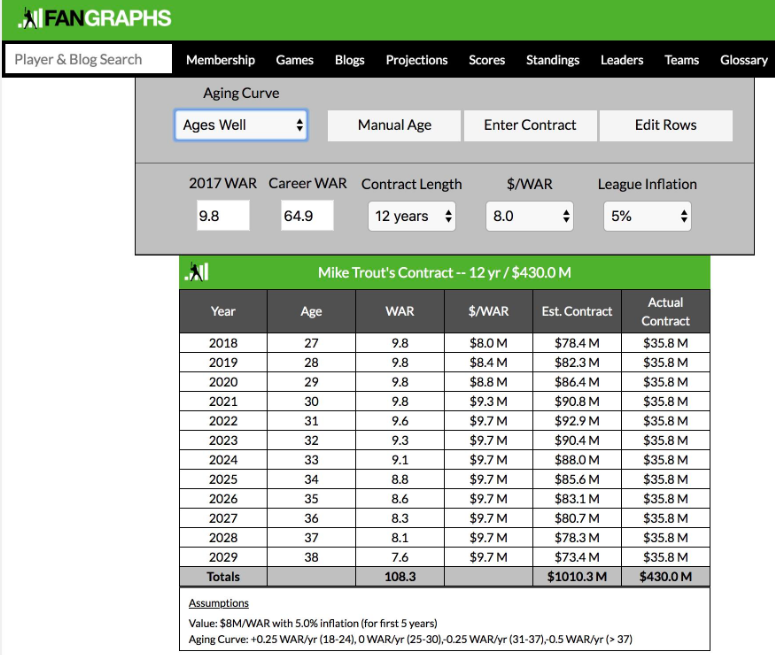
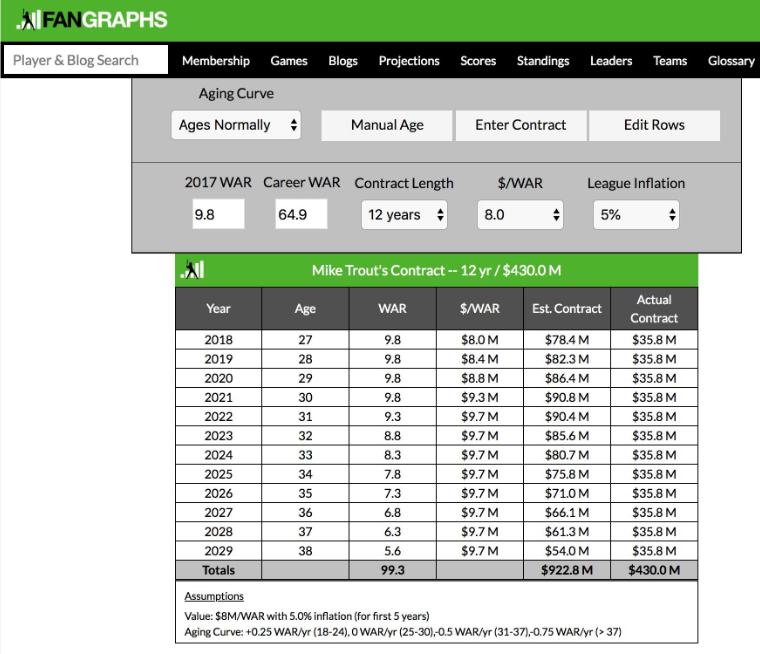
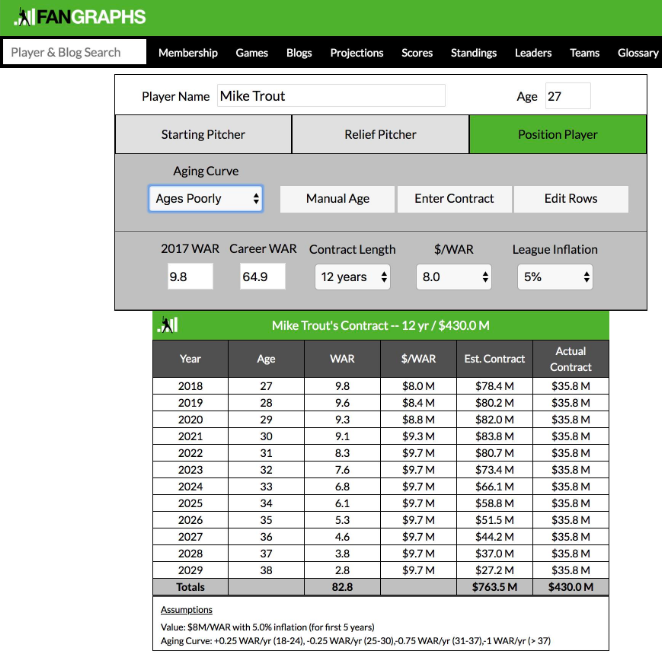
Thanks to the projection models over at FanGraphs, there’s also proof to back up that claim, as Ben Gellman-Chomsky pointed out on Twitter. FanGraphs has three different scenarios with which we can project a player’s future performance: aging well, aging normally, and aging poorly.

You can see how each of these scenarios would play out in Ben’s tweet, but here are the pictures so you can see them side by side.

First, if Trout ages well:

Next is Trout aging normally (well, for Mike Trout, at least):

Lastly, here’s what it’d look like if Trout ages poorly and the end of his contract isn’t nearly as enjoyable as the first portion of his career:

Let’s not forget that each of these fWAR totals is on top of what he’s already produced since debuting in 2011. If he beats the normal aging curve, Trout could finish his age-38 campaign with 173.2 career fWAR. That number would drop to 164.2 if he ages normally, and it “plummets” to 147.7 if he ages poorly.

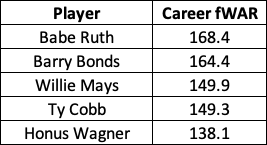
Things can obviously go haywire compared to these projections (after all, they’re called projections for a reason). But still, using this as a guide makes for an eye-popping observation. Below is a table of the top five players in baseball history when using fWAR as the benchmark:

Basically, FanGraphs is projecting Trout to finish this contract as the fifth-best player in baseball history when accounting for their worst-case scenario. The Angels would also almost double their money in that scenario when looking at the value of Trout’s performance.

If there’s any player in baseball that deserves this huge payday, it’s Trout. By the way he’s been producing, though, this could end up being viewed as a steal for Los Angeles. And that’s even more crazy to think about.


The Highest Paid MLB Players at Each Position

Even though the winter seemed to creep by at a slow pace, we saw some gaudy contract numbers eventually get tossed around. Manny Machado and Bryce Harper both became $300 million players, and Nolan Arenado set a record for average annual value. Let’s also not forget that Patrick Corbin turned a career year into a $140 million payday with the Washington Nationals.

Coincidentally enough, only one of them ends up on the 2019 All-Money Team. According to Spotrac’s payroll salary rankings, the following 11 ballplayers all have the honor of bringing home the most bacon at their respective positions by the time October rolls around. If you’re looking to put your money where your mouth is, then you can use your SugarHouse Sportsbook bonus code to place a wager on any of these big-money players’ teams during the 2019 Major League Baseball season.

Catcher: Buster Posey, San Francisco Giants

2019 Salary: $22.178 million

Sitting at the top of his position from an annual salary standpoint is a familiar feeling for the Giants’ backstop. He, Yadier Molina, and Russell Martin are the only three catchers in baseball making at least $20 million in 2019, with Yasmani Grandal checking in at fourth with his $16 million salary.

This past year was a weird one for Posey. A hip injury limited him to 105 games, 448 plate appearances, and 2.0 fWAR. It was the first time all three of those numbers were that low since 2011. Between these two occurrences, Posey never played in fewer than 140 games and was worth at least 4.0 fWAR on five occasions.

His power bottomed out in 2018 (five homers and a .098 ISO), which could be blamed on the hip injury. This is something that’s been going on for quite some time, though. Since slugging 22 homers with a .179 ISO in 2014, those numbers have gone down each following year.

One would probably imagine that he’d be struggling at the plate in San Francisco compared to being on the road, but not so much last year. In 212 home plate appearances, Posey posted a 149 wRC+ with a .136 ISO, compared to a 68 wRC+ and .065 ISO in 236 road plate appearances.

First Base: Miguel Cabrera, Detroit Tigers

2019 Salary: $30 million

This upcoming season is the second of six consecutive years in which Miguel Cabrera will earn at least $30 million. Despite a decrease in production compared to earlier in his career, he’s not sorry about it, either.

We’ve already talked about Miggy quite a bit this winter, and we’ve also done so recently. One of the many things to watch with the veteran first baseman will be his performance against curveballs. He struggled against that offering in 2017 to the tune of a .265 OPS, .034 ISO, 29.0% strikeout rate, and -22 wRC+. Despite the small sample size in 2018, those numbers all improved drastically to .747, .143, 18.2%, and 115, respectively.

However, Cabrera posted those numbers against curveballs despite a 70.6% ground-ball rate and 11.8% fly-ball rate (48.8% and 22.0% in ’17, respectively).

Second Base: Robinson Cano, New York Mets

2019 Salary: $24 million

Robinson Cano also takes his customary spot at the top, but is doing it in a new uniform this year. The gap between him and second place is interesting to note, as well. Dustin Pedroia is the league’s second-highest earner at the keystone, making $15.125 million this year with the Boston Red Sox.

It’s easy to see the concerns here — Cano is entering his age-36 campaign and is still fresh off last year’s PED suspension. The 80 games he played in was the lowest single-season total of his career. He had never played in fewer than 122 games during a single year, which happened all the way back in 2006. On the flip side, though, Cano’s body might be as fresh as it’s ever been since debuting with the New York Yankees in 2005.

As a ground-ball-heavy hitter, Cano’s rate of contact within the strike zone and his quality of contact will both be important stats to watch. His 92.3% contact rate on strikes was among the top-30 in baseball for players with at least 300 plate appearances last year, while his 41.5% hard-hit rate was a single-season career high.

Shortstop: Elvis Andrus, Texas Rangers

2019 Salary: $15.25 million

Technically, Troy Tulowitzki could be at the top of the shortstop money list. However, it’s time for some different faces, plus him getting released by the Toronto Blue Jays and picked up by the Yankees for the league minimum made this switch possible.

The Rangers shortstop appeared in 97 games during the 2018 season, which was easily a career-low mark. It was the first time he appeared in fewer than 145 games as a big-leaguer (he debuted in 2009). The most notable part of Andrus’ 2017 season was his homer binge. He launched 20 dingers, which was the first time he reached double digits in a single year. It was also more than his combined homers hit from 2014-16.

Despite the general lack of opportunity, Andrus only slugged six dingers last year, which was more in line with his career norms. With a fly-ball rate that typically hovers around 30-31%, it’s imperative for him to take advantage of the balls he does get in the air. In 2017, the 30-year-old posted a 146 wRC+, .500 ISO, and 36.1% hard-hit rate on fly balls. Those numbers all decreased significantly this past year to 11, .235, and 26.2%, respectively.

Third Base: Nolan Arenado, Colorado Rockies

2019 Salary: $26 million

Even if Arenado didn’t get the huge eight-year contract he just signed with the Rockies, his 2019 salary would’ve landed him at the top of the hot corner money rankings. It’s about time, too — the third baseman has been a steal from a value perspective for Colorado for quite some time.

While there was a distinct difference between his home numbers (161 wRC, 1.105 OPS) and road numbers (104 wRC+, .772 OPS), he was rather consistent for most of 2018. His monthly wRC+ production dipped below 100 just once (97 in August) and was above 114 in every other calendar month. The same could be said for his power production — Arenado’s ISO fell below .200 in only one month (August again, .143).

He’s led the National League in homers three times, RBI twice, and hasn’t let any other NL third baseman win a Gold Glove award since debuting in 2013. Seems as if this guy is the whole package, and the Rockies don’t have to worry about the Yankees or anyone else trying to steal him from them next winter.

Left Field: Yoenis Cespedes, New York Mets

2019 Salary: $29 million

It’s probably shocking to hear this, but the Mets’ long-term commitment to Yoenis Cespedes hasn’t worked out so far. Through the first two seasons of his four-year, $110 million contract, Cespedes has suited up for just 119 games, leading to 478 plate appearances. And as he recovers from surgery on both heels, it’s unknown how much time he’ll miss this season.

They have been abbreviated campaigns, but Cespedes has turned to a heavy fly-ball approach since 2017. He posted a 49.6% fly-ball rate in ’17, followed by a 52.6% rate this past year. The outfielder did pair that first number with a 42.2% hard-hit rate, which proceeded to drop to 33.3% in ’18.

He also struggled within the strike zone, evidenced by an elevated swinging-strike rate (13.5%) and strikeout rate (31.8%). It’s worth noting that those struggles happened mostly in April, where he owned a 38.1% strikeout rate. Despite accruing just 39 plate appearances in May before having his season end prematurely, his strikeout rate was back down to 17.9%, which is much more like Cespedes’ career norms.

Center Field: Mike Trout, Los Angeles Angels

2019 Salary: $34.083 million

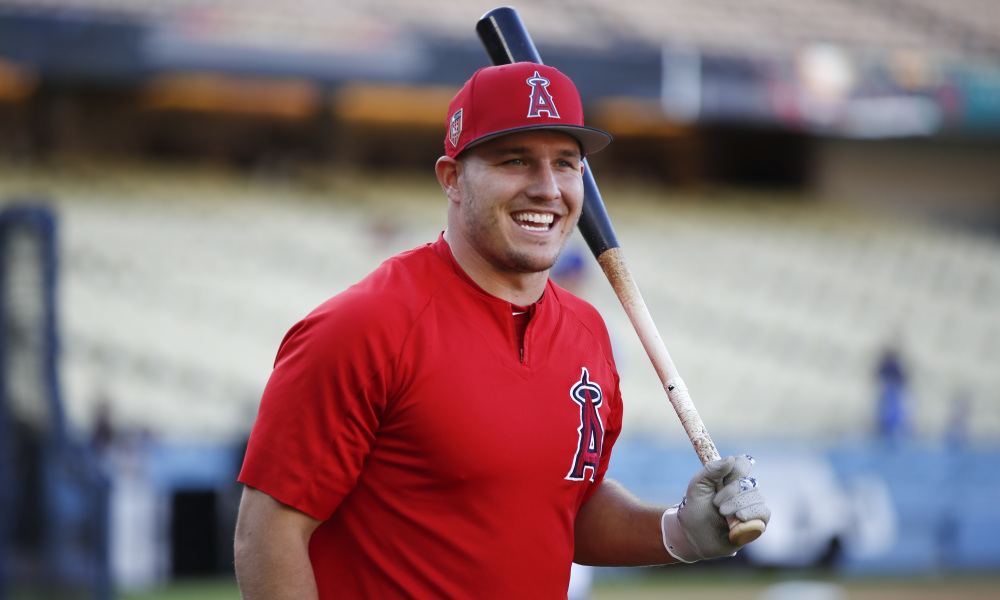
Mike Trout is the highest-paid position player in baseball, but it is the very definition of a bargain. I mean, what else can you say about a 27-year-old that could already get elected to the Hall of Fame if his career ended today?

Since debuting in 2012, Trout has posted an fWAR of at least 9.0 on five different occasions. When using FanGraphs’ Dollars metric, his performance have been worth at least $65 million on six different occasions. The one time it didn’t happen was in 2017, when his 6.9 fWAR was worth “just” $54.9 million due to hitting the injured list for the first time in his career.

Trout’s plate discipline continues to improve as well. After posting an 11.8% walk rate in 2014, that number has increased in each of the following four years, culminating with a career-high 20.1% clip in ’18. He’s also found a way to increase his wRC+ and OPS in each of the last three years. The dude is just not human.

Right Field: Jason Heyward, Chicago Cubs

2019 Salary: $22.5 million

Jayson Heyward brings value to the Cubs, but there’s no doubt the front office wished they could’ve taken this money and awarded it to Bryce Harper on an annual basis for the foreseeable future. He’s won two Gold Gloves during his first three years in Chicago, but the offensive side of his game hasn’t gone well.

The 29-year-old posted a career-high 5.6 fWAR with the St. Louis Cardinals in 2015. In three seasons with the Cubs, his combined fWAR is 4.0. He’s never been one to light up the quality-of-contact leaderboards on a consistent basis, but his soft-contact rate has been incredibly high since arriving at Wrigley. That number hasn’t been lower than 25.0% during his current contract.

Fastballs haven’t typically been a problem for Heyward — it’s secondary pitches. The curveball was especially tough on him in 2018. He produced a -15 wRC+ against that offering last year, along with a .286 OPS, and 25.0% infield-fly rate.

Designated Hitter: Albert Pujols, Los Angeles Angels

2019 Salary: $28 million

Albert Pujols’ offense wasn’t quite as bad in 2018 as it was in 2017, but it was still below average. It was also the second consecutive year in which he produced a negative fWAR. However, it is interesting that his 42.4% hard-hit rate hadn’t been that high since 2010, while his 22.3% line-drive rate hadn’t been that high since 2008.

The Machine’s declining performance on fly balls isn’t helpful, though. Since posting a 185 wRC+ for this batted-ball event in 2015, that number has gone down each year that’s followed, bottoming out at 88 in ’18. Of the four months he suited up for last year, Pujols produced an overall wRC+ above 87 just once, when it settled in at 153 during the month of July.

Everyone knew this contract would be a mess toward the end, and that’s exactly what’s happening. He’s under contract through 2021, with his salaries increasing to $29 million in ’20 and $30 million ’21 before reaching free agency again.

Starting Pitcher: Stephen Strasburg, Washington Nationals

2019 Salary: $38.33 million

It’s weird not seeing Clayton Kershaw here, right? Strasburg actually barely beats out teammate Max Scherzer, whose payroll salary comes in just shy of $34.5 million for the 2019 season. The Nationals’ former top overall pick threw just 130 innings last year, but continues to be an above-average rotation contributor.

What’s changed rather drastically over the years is a decreasing reliance on his fastball. After tossing it at a 63.4% clip in 2015, that number has dropped to 51.9% each of the last two years. Strasburg’s changeup (19.9%) and curveball (19.6%) have seen an uptick in usage as a result.

They’ve both been elite weapons for him. Over the last three years, each offering has generated a strikeout rate of at least 40.0% and an opponent wRC+ no higher than 70. Opposing hitters have also failed to post an ISO above .100 on either pitch for the last two years.

Relief Pitcher: Kenley Jansen, Los Angeles Dodgers

2019 Salary: $19.33 million

Kenley Jansen’s overall production certainly took a step back in 2018 compared to the two years prior. After enjoying two straight seasons with a 40.0%-plus strikeout rate, 3.0-plus fWAR, and sub-2.00 ERA, those numbers settled in at 28.4%, 0.4, and 3.01, respectively.

This year is important to Jansen for all the obvious reasons, but also with regard to his contract. The five-year deal he signed to stay in Los Angeles includes player opt-outs in each of the final two seasons. If the 31-year-old has hopes of re-entering the free-agent market (who would if they don’t have to right now?), then that dominance he’s previously shown needs to return.

2020 MLB Free-Agents Who Need a Big 2019

Based on how the last two winters have gone, the MLB Hot Stove we’ve always known and loved has fundamentally changed.

It’s the only reason why we can explain this year’s top free agents — Manny Machado and Bryce Harper — didn’t sign new deals until spring training was already underway. And let’s not forget about the growing number of veterans either still out of work or accepting non-guaranteed deals. What’s transpired has also urged some of today’s top talent, like Luis Severino and Aaron Nola, to agree to extensions that appear as though they’ll end up being quite team-friendly.

Major League Baseball is a results-based business, so every year is important for those taking the field on a daily basis. Given the current labor climate, that level of importance increases even more for those on the brink of free agency. The following 10 ballplayers are currently set to hit the open market at the conclusion of the 2019 campaign. When it comes to their ultimate earning power and the kind of contract they’ll have a chance to receive, their performance over the next six or seven months will be crucial. If you are looking to bet on baseball, then these players are the ones to watch since they will be very motivated to perform in 2019. You can now participate in NJ Sports Betting since gambling on sports is now legal in the state.

Yasmani Grandal, Milwaukee Brewers

Although Yasmani Grandal’s current contract includes a mutual option for 2020, there’s a good chance he’ll be a free agent for the second consecutive offseason. He joins a handful of players on this list in that same situation, but it was by choice for the veteran catcher.

The former Los Angeles Dodger drew interest from at least the Minnesota Twins and New York Mets on a multi-year basis. He ultimately opted for Milwaukee’s one-year offer because he wanted to continue setting the standard for the top players at his position with regard to average annual value. He accomplished that by signing with the Brewers — his $16 million salary is fourth-highest in baseball among catchers despite the obvious gamble on himself.

The 30-year-old is looking for 2019 to be his fourth consecutive season of 20-plus homers, and being in Milwaukee for home games should help make that happen. Of his 24 homers from last year, 20 came as a left-handed batter, accompanied by a .240 ISO. According to Baseball Prospectus’ park factors by handedness, Miller Park was one of the best places to hit homers for left-handed sluggers in 2018.

Gerrit Cole, Houston Astros

Following a 5.5-fWAR performance with the Pittsburgh Pirates in 2015, Gerrit Cole failed to approach those numbers in the two years that followed. He did that and then some in 2018 for the Astros, posting a 2.88 ERA and 1.03 WHIP with a 34.5% strikeout rate and 8.0% walk rate. This production led to a 6.3 fWAR and a top-five finish in AL Cy Young voting.

Probably one of the most drastic changes in this career year was a drop in ground-ball rate. Cole had never seen that number dip below 45.6% in a single season before 2018, when it settled in at 36.0%.

Instead of accepting what the Astros wanted to pay him this year, Cole went to arbitration and beat Houston, winning the right to earn $13.5 million in 2019 (he earned $6.75 million last year). The right-hander has a mostly solid track record and pedigree since debuting in 2013. His recent uptick in production likely would’ve played well if he was a free agent this past winter (look at how that worked out for Patrick Corbin).

Cole doesn’t necessarily need to repeat what he just did, but he needs to show it’s somewhat sustainable to get close to the payday agent Scott Boras will likely be searching for.

Jose Abreu, Chicago White Sox

When strictly looking at counting stats, Jose Abreu has been very consistent. He’s notched at least 20 homers each season since debuting in 2014 and has also added 100-plus RBI to that on four different occasions. His 22 dingers and 68 RBI were both single-season career lows in 2018, but those weren’t the only things that took a dip.

Abreu watched his wRC+ (114), OPS (.798), and fWAR (1.2) drop to career-low marks, too. His batted-ball profile didn’t show much change outside of a .294 BABIP, which was also a career low (it had never been below .327 in a single season prior to ’18). So it seems as if tough luck played a part in some of Abreu’s decreased production.

He at least had himself a strong second half after struggling before the All-Star break. Having a typical year at the plate will be even more important this year because of both his looming free agency and role on the White Sox. Abreu has never been a stellar defender, but Chicago’s acquisition of Yonder Alonso will push him to designated hitter much more often than before.

Sure, a universal designated hitter may be on the horizon. However, the 32-year-old’s earning power could take even more of a hit if his time on the field gets significantly decreased and his offense doesn’t bounce back.

Matt Harvey, Los Angeles Angels

Toward the end of 2015, most would’ve laughed at starting pitcher Matt Harvey settling for a one-year, $11 million contract in his first trip through free agency. Unfortunately, injuries combined with some poor off-field choices in New York have completely changed the trajectory of his career.

After getting traded early in 2018 to the Cincinnati Reds, Harvey mostly looked like a serviceable MLB starter again. Over 128 innings, he hurled a 4.50 ERA with a 1.25 WHIP, 20.6% strikeout rate, 5.2% walk rate, and 1.5 fWAR. Those were (mostly) all vast improvements compared to what he did with the Mets in injury-shortened seasons of 2016 and 2017.

The upcoming campaign is crucial for all the obvious reasons — he gets another fresh start in a new city (and league), will be starting every fifth day, and has another chance to recoup some value before re-entering the market. Two things he’ll need to get under control to have a successful year include his hard-hit rate (38.9% in ’18, increased each year since ’13) and his homers allowed per nine innings (1.57 in ’18 and 2.04 in ’17).

MLB Players Up for Big Paydays

It took longer than anyone would’ve expected, but 26-year-old outfielder Bryce Harper and his agent, Scott Boras, got the record-setting payday they were searching for.

As virtually everyone is aware of by now, Harper is a Philadelphia Phillie after signing a 13-year, $330 million contract. This deal includes a no-trade clause, which isn’t shocking, but it also doesn’t include any opt-outs, which is typically a staple for Boras clients. It turns out the left-handed slugger didn’t want one. Heck, after going through a long and drawn-out free-agent process this past winter, who could blame him?

He just barely beat out Giancarlo Stanton’s 13-year, $325 million contract that he signed with the Miami Marlins back in 2014. And while the ink has barely dried on Harper’s new deal, the record he just set probably won’t stand for very long. Baseball fans are already making wagers about the next big baseball moves on bet-michigan.com and other online sports books.

The following eight MLB players have, at the very least, a chance of surpassing that $330 million benchmark. In some cases, it will be more of a no-brainer than others — and this is by no means an exhaustive list — but the conversation is valid to a degree for all of them.

Mike Trout, Los Angeles Angels

Um…duh. Trout had to be mentioned first on this list because it would’ve been disrespectful if he wasn’t. Mere days after Harper’s deal with the Phillies became official, Ken Rosenthal of The Athletic reported that the Angels have considered offering the face of their franchise a 10-year, $350 million deal.

Based on what Trout has accomplished since 2012, this offer feels like more of a starting point than an end point. He’s racked up seven All-Star Game appearances, six Silver Slugger awards, the 2012 American League Rookie of the Year, and two AL MVPs. Oh, and five other top-five finishes in MVP voting (four second-place finishes).

As we mentioned in an article from earlier this winter, the best way to show how much better Trout has been than the rest of baseball is by looking at his fWAR. Here’s an excerpt from that piece:

Entering 2019, his fWAR is 16.9 wins greater than Joey Votto. The distance between Trout and second place is the same as it is from second place to 18th place, which is where Freddie Freeman is taking up residence (30.8 fWAR).

Trout will be pushing 30 years old if Los Angeles doesn’t lock him up prior to his walk year, and teams are more averse to these kinds of contracts for the second half of a player’s career. However, there are no signs of Trout slowing down — he’s actually getting better in some respects.

The 2018 season was his third 9.0-plus fWAR performance in the last four years and his third straight 20-20 season, along with setting single-season career highs in walk rate (20.1%), wRC+ (191), OPS (1.088), and hard-hit rate (44.4%).

Juan Soto, Washington Nationals

Losing Harper to a division rival certainly stings, but it’s not as if the Nationals aren’t expected to contend for a postseason spot this year. The presence of Juan Soto is a big reason for this, and Washington would’ve been a lot worse than its 82-80 record last year without him.

What’s crazy is that he spent 116 games in the big leagues in 2018 despite starting the year in Single-A ball. In fact, Soto’s career minor-league plate appearances (512) is barely more than the big-league plate appearances (494) he just accrued.

Every number from Soto’s stellar rookie campaign is impressive, whether it’s the 3.7 fWAR, 146 wRC+, or .923 OPS. However, his 16.0% walk rate is easily the most eye-popping of all. It’s not every day we get to see a then-19-year-old rookie show off that kind of plate discipline. His 21.9% chase rate would’ve ranked 12th in baseball had he qualified for the batting title. He actually finished just a hair beyond some fellow named Mike Trout (21.8%).

There’s still plenty of work ahead for Soto as he prepares for his sophomore season. But still, it’s hard to not be making comparisons with Harper, who was the Nats’ last 19-year-old superstar. If Soto can find a way to keep progressing, Washington may have another big contract decision to make in a few years with, yup, you guessed it — another Scott Boras client (at the moment, at least).

Kris Bryant, Chicago Cubs

Putting Bryant on this list is one of the riskiest calls based off the 2018 he just had and the fact that he’s currently slated to hit free agency at the age of 30. His prior track record is sparkling enough to withstand one tough year that was slowed by a shoulder injury, though.

The third baseman already has an NL Rookie of the Year Award, two All-Star Game appearances, an NL MVP, and of course, a World Series title to his name since debuting in 2015. Despite not displaying his typical power last year (13 homers and .188 ISO in 457 plate appearances), he still managed to produce a 125 wRC+ and 2.3 fWAR.

While he missed 60 games in ’18, Bryant’s 23.1 total fWAR since the start of 2015 is the best among all third baseman. He’s also only three months younger than Nolan Arenado, who just cashed in on a huge payday from the Colorado Rockies. Bryant still has some time before hitting the open market, but 2019 will be crucial to how the rest of his tenure with the Cubs goes.

Can he bounce right back and prove he’s still worthy of such a huge financial commitment? His 1.160 OPS through 17 spring-training at-bats tells us that will probably be the case. A key for the soon-to-be 28-year-old is his quality of contact. After posting hard-hit rates of 37.5% and 40.3% in his first two big-league seasons, that number decreased to 32.8% and 31.2% in the last two.

Aaron Judge, New York Yankees

Judge is even more of a borderline case here because of his age. He’s the same age as Harper and Machado, yet isn’t set to hit free agency until the 2022 season is done (his age-30 campaign). That alone may prevent him for getting $330-plus million, but his potential production could sure make it an interesting debate.

Injuries limited him to 27 homers in 498 plate appearances last year. If he stepped into the batter’s box closer to the 678 times he did as a rookie, though, he could’ve had a shot at another season of 40-plus homers. The 2019 campaign will be crucial for Judge because it’s his platform year before heading through the arbitration process.

If he can stay healthy and put up more monster numbers, one has to imagine he’ll break some kind of record for a first-time arbitration-eligible player. That’s especially the case since he’s not a one-dimensional slugger — he’s been worth at least 5.0 fWAR each of the last two seasons with a wRC+ of at least 140, along with 23 total Defensive Runs Saved as a right fielder during this time.

OLYMPIC GAMES 2020: THE PROCESS OF PREPARATION

As you already know, next year’s Olympic Games will take place in the land of the Rising Sun, Japan. After 56 years, the capital of Japan will welcome another significant summer event and host the 2020 Olympic Games. Back in 1964 Olympiad greatly transformed the country, which since that time has developed into the nation with one of the fastest-growing and largest economies in the world and baffled everyone else by its unsurpassed technological achievements. The organizers say that they will change dramatically the way countries used to prepare for these tournaments, and the next Olympiad will be organized with the help of the most innovative and advanced technologies and modern equipment.

Most of the venues built for the 1964 Summer Games will be used again next year as required according to Olympic Agenda 2020. To name but a few, some sites like Baji Koen Park for equestrian events, Yoyogi National Gymnasium for handball, Nippon Budokan for judo will be renovated and ready to host tournament once more in 2020. The Tokyo National Stadium is said to be renewed and modernized for the upcoming event and will host the Opening and Closing of the ceremony.

Japan was the first Asian country to host Summer Olympic Games back in 1964, and since then it had a chance to stage two more Winter Games in Sapporo and Nagano, and one more is on its way.

Japan will attempt to make its way into history as one of the countries that changed the principle of crafting the medals for the event. The fact is, Tokyo will be among the first countries to make the medals for the contestants from recycled smartphones, digital cameras and other gadgets no longer serving their owners. That’s a perfect solution to keep up with modern eco-friendly tendencies.

Officials met this decision with enthusiasm and support. It was declared that the organizing committee will have collected a number of obsolete devices enough to extract gold, silver and bronze particles to make the needed quantity of rewards by the end of March. Total weight of the materials collected is 6,830 kg, out of which gold constitutes about 30 kg. This material has proved itself to be hard to find in recycled gadgets, nevertheless, organizers are determined to collect the needed amount in time.

Last summer Olympic Games in Rio have already seen this kind of innovation, then, medals were made from the recycled material. However, Japan is the first country where the citizens themselves are actively involved in the process of donation of electronic devices for recycling purposes.

Winning a medal at the Olympic Games is the highest honor and the feeling that can be only compared to winning a jackpot at the largest casino. That’s why coming up with an innovative and eco-friendly solution for the medal (or any other) production is highly appreciated and welcomed when we talk about major events.

On the other hand, perhaps, this act is just a way to make eco-activists forget about Japan’s membership withdrawal from the International Whaling Commission and their decision to resume commercial whale hunting, which they explain as a part of the country’s culture. Maybe, they even try to make up for the fact that Japan uses precious rainforest wood to build the venues for the event, destroying natural habitat for rare species of animals.

It’s been noted by environmental activists that Japan uses this wood against the accordance to preserve the sustainability of the Olympic Games 2020. The material has been supplied from threatened Asian forest to build facilities to host the Olympics, and it’s said to damage the ecosystem and biodiversity of the regions of Indonesia and Malaysia.

Even though the organizers pledged to ensure the eco-friendliness of the event, environmental activists are afraid that the illegal wood has also been used to build a huge new national stadium.

The most dangerous side effect of such irresponsible actions is the impact it has on the population of orangutans leaving in threatened forests and damaging their natural habitat. The ecologists have already noticed the decrease in population of these species, and now animals have to find new homes outside protected areas, which makes them profoundly vulnerable.

The commitment made by organizers of the Games 2020 made them ensure the absence of unsustainable material and illegally logged timber in the construction of the facilities for the event, but as for now, they don’t have to prove the source nor reveal the traces of the timber of which they construct the venues.  This fact makes it hard to prove the illegibility of their actions and stop the deforestation of south-east Asian rainforests.

Nevertheless, considering all the facts mentioned above, the world is already waiting with anticipation for the next summer Olympics, and athletes are in active process of preparation for the event. 2020 won’t bring any major changes into the way the Games are held, but 2024 might include breakdancing as a new Olympic sport.

How to Focus on your Games while Paying off Massive Debt

Playing games could be relaxing, more so when you always win. But in order to win, you need to focus on your games because when you are anxious about something, it gets you distracted. The magnitude of the distraction depends on what kind of problem you are anxious about. But what if your distraction is minding so much about your massive debts? How do you do about it? How can you keep your focus on your games when you have this kind of problem? This blog discusses some tips in order for you to cease and desist becoming problematic about your debts.

Focus on the Here and Now

Focusing is really hard especially when you are preoccupied with your loans. But the only way to maintain your focus is by setting an order of priority. When you are playing games, stop thinking about your debts. Most people have a tendency to think about their problems while they are doing something. As a result, the current task fails and you turned out to be more disappointed. To avoid this from happening, do not mix up what you feel with what you do. Besides, you cannot solve your debt while doing your tasks or playing games so why mix it up. Mind over matter. Mind your debts before or after the game.

Make a Concrete Action Plan to Pay your Debts

People are usually anxious about something because they feel that they do not have a hold or control over things. They might be overwhelmed and may not anymore recover from it. This anxiety is often caused by not planning because planning may give you a sense of control. In response, make a concrete action plan or strategy in paying off your debt. In your plan, determine which among your debts have the highest interest and with the lowest amount of term payments. Match it with your current income, and make a schedule of payment in terms. Upon doing this, you will realize that paying your debt, how massive it can be, is still doable and achievable. Hence, you will have less anxiety and focus on your game.

Take Action Now

It is not enough that you make an action plan, you have to take action as you planned. Besides, that is why it is called an “action plan.” When you plan to pay your debts according to the order of priority, make sure to pay the terms religiously. Prioritize paying your debts over unnecessary spending of wants. Only buy things that you need. This is called “delayed gratification.” Of course, part of your action plan is to increase your income because your income might not be able to cover all the things that you need. Maybe your income can cover only your debts, but how about your necessities? As always, the best formula is to reduce your expenses and increase your income.

Have Discipline

Your plan and action will only work if you have the discipline enough to control your bad habits and continue your good habits. There may be times when people might taunt or ridicule you for being frugal and may brand you as materialistic when you have a lot of extra income. You might be carried away and go back to where you were. Do not mind them. You cannot control what they might say about you but you have complete control over your thoughts, feelings, and actions. Therefore, the only person who can discipline you is only you.

Conclusion

When you know what to do about your problems, especially paying off your massive debts, then it gives you more confidence in doing your other activities such as games. In games, though it is only for leisure, it provides you with a certain level of rest and recreation. Thus, when you mixed up being preoccupied with your debts while playing games, it is definitely stressful. Meanwhile, in order to stay focused, you have to do the following. Have an order of priority, make plan paying your debt and do it, take some sacrifices and discipline yourself. By following these, you are changing yourself for the better. Many of your potentials may be harnessed and you may be able to overcome your stresses in life. Enjoy life to the fullest.

The Odds between Sports Betting and Online Casinos

There is a wide range of bets you can make to endeavor to create a benefit. A few diversions, for example, the spaces are down to nothing but fortunes and others include a component of aptitude to build odds of winning.

For example, sports wagering. New online gambling clubs ordinarily keep running on irregular number generator programming which implies that a program race to guarantee an arbitrary arrangement of numbers alongside delivering the house edge required to make clubhouse gainful.

Betting, then again, is viewed as a type of gambling. All the more correctly, betting is tied in with foreseeing the probability of a future occasion and putting money on it (mostly, to get a “casino bonus“).

Authoritatively, Betting is distinguished as a composed business action between two gatherings – there is one that predicts an outcome and puts down a wager and the other who either relinquishes the bet or pays the concurred cash to the player. At the point when the chance is included, compensate rapidly pursues.

Numerous games fans love to put down a bet as a source of pure entertainment. This isn’t the primary choice out there for those that need to strike it fortunate, however, as you can likewise bet in an online clubhouse.

We look at some of the key differences that help understand the contrasts between Sports Betting and Online Casinos

The Primary Difference (By Definition)

As Betting alludes to foreseeing the result of a future occasion, individuals who put down wagers endeavor to win cash via cautiously anticipating the outcome of a Betted occasion. While Betting isn’t so hazardous and unsure, gambling then again depends altogether on the hypothesis of likelihood. At the point when individuals bet, their outcomes shift among wins and setbacks, which is the reason most players would concur betting offers preferable fervor over the betting does.

The House Edge: A Key Difference

One of the first contrasts between casino-based gambling and sports betting is the way that casino amusements have a “House Edge.” This is the measure of benefit the house is set to make on each game played over the long haul. Without this setup, the casinos would leave business as it is the sole factor that guarantees huge profit margins.

The “Jackpot”

The Jackpot Prizes at on online/offline based casino games are much bigger, and they are offered more routinely than those by games bookmakers (or “bookies”). This is because online gambling casino original cash games have devoted and consistent big stakes like casino bonus rounds. There are big stationary stakes which are accessible in each diversion, and after that, there are dynamic stakes which can pay out a great many dollars.

Conclusively, with everything taken into account, whichever way that you roll your cash online can be fulfilling. On the off chance that you adore sports, at that point, there are even sport-based casino recreations that you can peruse. There are such a large number of choices out there for you, all you need is a handset and Internet Access to avail them.