The internet had its moment. Jeff Goodman called it “one of the worst trades I’ve seen in a long time.” ESPN handed the Celtics a D+. Twitter’s NBA discourse machine, which runs on outrage and recency bias, spent July 1st treating Brad Stevens like a man who had just traded a Vermeer for a faded poster reproduction.
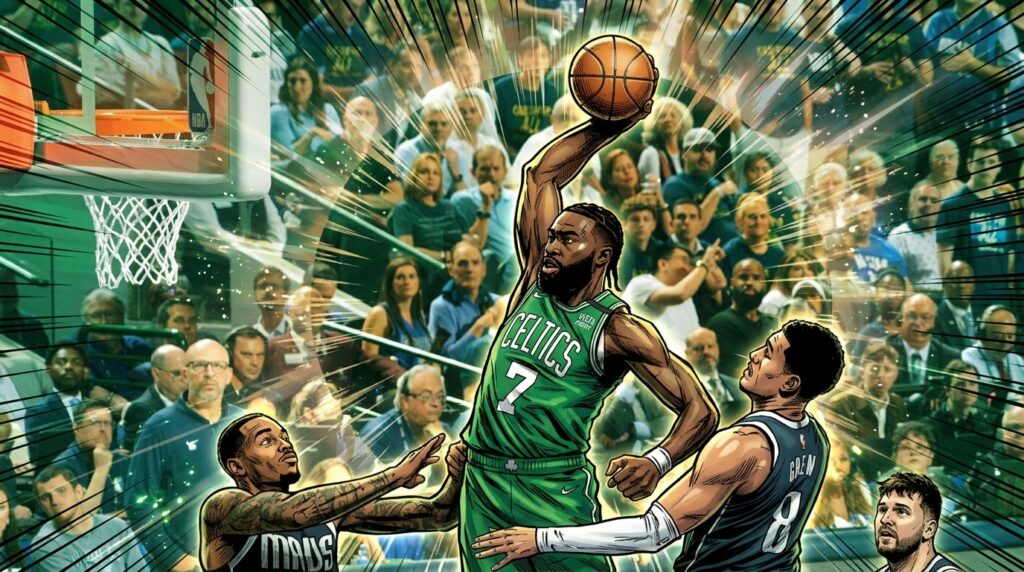
The Jaylen Brown deal — Brown to Philadelphia, Paul George plus four picks (two first-round picks, two seconds) back to Boston — is, by almost every hot-take metric, indefensible. Brown was the 2024 Finals MVP. He won 7 of 11 MVP votes. He averaged 20.8 points, 5.4 rebounds, and 5.0 assists in that run against Dallas. The Celtics’ 18th title was supposed to be the beginning of something, not a peak to trade away from.
George is 36. He served a 25-game drug suspension in January, something he attributed to mental health struggles following his knee injury. Over the past seven seasons, he has played 62% of possible games — 341 of 554. These are real concerns, not manufactured ones.
But we have been in this exact parking lot before, and we know how the movie ends.
The Porzingis Panic Playbook: We’ve Been Here Before
When the Celtics acquired Kristaps Porzingis before the 2023-24 season, the reaction from the basketball internet was not optimism. It was skepticism bordering on alarm. Porzingis had a lengthy injury history. He had plantar fasciitis. He was a “high-risk, high-reward” player — which is the polite way of saying most analysts thought the risk outweighed the reward. He averaged 20.1 points that season and then, during the actual Finals — while dealing with the plantar fasciitis that was supposed to sideline him — came back and helped close out the Dallas Mavericks in five games.
Yes, Porzingis was nine years younger when the Celtics made that bet — the risk profile is different at 36, and nobody should pretend otherwise. The point isn’t that the situations are identical. The point is that Brad Stevens runs the medical, runs the analytics, and then makes the call.
The lesson from that trade is not that Stevens is some omniscient roster builder who never makes mistakes. The lesson is that “this guy has injury history” is an incomplete analysis when the player in question is genuinely talented and the front office has earned credibility. Stevens has earned credibility. Repeatedly.
So when CelticsBlog writes that “if he is on the floor, and that is a big if, Paul George is going to help the Celtics win games next season,” that framing is actually more honest than most takes — and also more useful. Nobody is promising George stays healthy. Nobody should. But “high-risk player who is very good when available” described Porzingis circa 2023, too.
What Paul George Actually Gives This Celtics Roster
Here is a number that got lost in the noise: Paul George shot 49% from the field and 55% from three in this past playoff series against the Celtics. Forty-nine and fifty-five. Celtics beat writer Brian Robb put it plainly: “Paul George outplayed Jaylen Brown in the first round this year. Can’t say I expected that to lead to this.”
Paul George outplayed Jaylen Brown in the first round this year. Can't say I expected that to lead to this.
— Brian Robb (@BrianTRobb) July 1, 2026
He averaged 17.4 points in that series at those efficiencies. In the regular season: 17.3 points, 5.3 rebounds, 3.6 assists, 1.7 steals in 37 games. He shot 39% from three, which is a legitimate wing contributor number.
George at his best is a two-way wing with size, shot creation ability, and the defensive instincts that made him one of the better two-way players of his generation. At 36 and post-suspension, he is not that player every night. But what the Celtics need is not a cornerstone — they have Jayson Tatum for that — they need a secondary creator and a wing who can guard the other team’s best perimeter player without breaking the offense. When George is right, he does both.
The Contract Isn’t the Problem You Think It Is
Brown had roughly $70 million more remaining on his deal than George does. George is owed $54.1 million next season, with a $56.6 million player option for 2027-28. That is a total commitment somewhere around $110.7 million — real money, yes, but Brown’s remaining obligation was substantially larger and his contract structure made the Celtics a second-apron team with almost no flexibility.
The new CBA’s second-apron rules — the ones that restrict trade exceptions, limit the ability to aggregate salaries, and prevent teams from signing players above the minimum — are not a soft penalty. They are a hard wall. Operating above the second apron for consecutive years turns roster management into an exercise in hoping nothing breaks. Brown’s contract made that the operating condition in Boston for years. George’s shorter, lighter commitment gives Stevens actual tools to work with.
This is not to say the picks are nothing — two first-round picks (the 2028 pick with possible swap provisions) are real assets. But the front office clearly ran the math and decided the second-apron prison was a worse long-term outcome than trading a Finals MVP and getting something back. That calculus can be wrong. It can also be right.
Why Brad Stevens Probably Knows Something We Don’t
The drug suspension came with context George himself provided. “The most difficult thing,” he said, “is when your body isn’t where you know it needs to be or where it once was. That leads and bleeds into the mental side of things.” That is not the language of someone who stopped caring. It is the language of someone who went through something hard and came out the other side still playing basketball at a high level — as the playoff numbers from this past spring demonstrate.
Stevens has built and rebuilt this roster through the Al Horford return, the Ime Udoka situation, the Smart trade, the Porzingis gamble. He has been wrong before. He will be wrong again. But the track record suggests he does not make major roster moves without understanding what he is buying — which means the medical evaluation on George’s knees is probably more thorough than anything available to the people who spent July 1st posting takes.
The 2025 season ended with the Knicks beating the Celtics in the conference semis. OKC won the title. This team, as constructed, had already hit a wall. The question was never whether to change something — it was whether this change makes sense. It might. George’s age and health history are real reasons to worry. But so was Porzingis’s plantar fasciitis, and that one worked out fine.
The Celtics have been here before. They knew what they were doing then. The working assumption, until proven otherwise, is that they know what they are doing now.